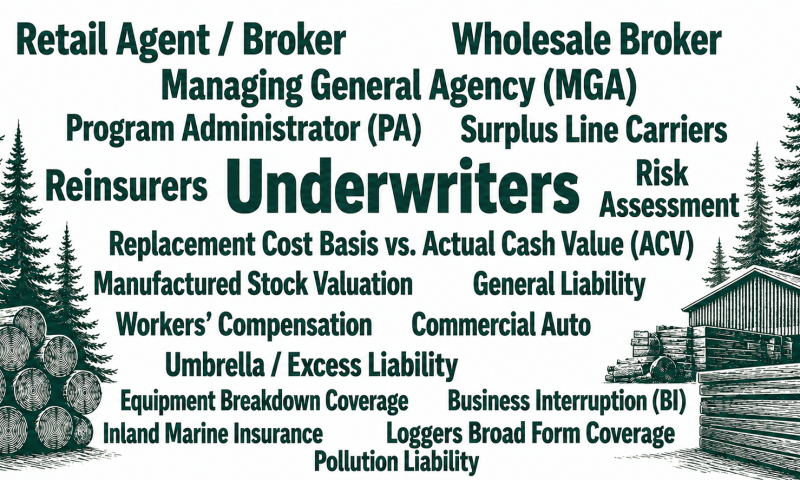
Speaking Forest Products Insurance: Terminology for the Forest Products Industry
As we said in a past article on Specialists vs. Generalists, all of our employees have seen sawmill, planing mill, and debarker equipment up close. We understand that your forest products business faces risks that most general insurance policies weren’t built to handle.
Whether you’re a sawmill owner who wants to better understand your coverage, or a broker who is new to the space, here are some of the key terms and concepts that you’ll need to “speak” forest products insurance.
How Forest Products Insurance Is Structured Differently
Forest products insurance differs from your typical commercial lines at the structural level—here are a few of the key players and concepts to understand.
Retail Agent / Broker: A professional responsible for selling insurance policies, servicing client accounts, and maintaining direct communication with the insured.
Wholesale Broker: A broker who acts as an intermediary between retail agents and insurance carriers to secure specialized coverage for high-risk or unique insureds.
Managing General Agency (MGA): A specialized entity with the authority to underwrite, bind, and service insurance policies for delegated markets. MGAs also serve as intermediaries between agents and carriers. Continental Underwriters is an MGA. 😉
Program Administrator (PA): An MGA who designs and manages insurance programs tailored to specific industries. For instance, Continental Underwriters is a PA that collaborates with over 30 carriers to create insurance programs for businesses in the forest products industry.
Surplus Line Carriers: Insurers that write specialty risks, often involving high-hazard situations, which fall outside the standard (or admitted) insurance market.
Reinsurers: Insurers that provide financial backing to primary carriers, such as Excess & Surplus (E&S) lines, enabling them to operate more safely and efficiently. Strong reinsurance capacity in the marketplace can improve overall rates, which is why MGAs must understand the reinsurance backing of their carriers, as it impacts coverage limits and pricing.
Underwriters: Professionals who assess risk, determine appropriate coverage, and establish pricing. Forest products underwriters like those at Continental Underwriters possess deep industry knowledge as these operations typically involve high-value assets (buildings, equipment, inventory, etc.) and have significant loss potential.
Risk Assessment: Professionals who focus on minimizing risk in new construction, existing systems, and operational procedures. The expertise such as that provided by our team at Continental Underwriters not only helps forest products businesses reduce exposure but also enhances their insurability and improves pricing.
Essential Forest Products Coverage Lines
Commercial Property
Property insurance covers the physical assets of an operation (buildings, equipment, inventory, etc.). For sawmills and other wood product manufacturers, key assets include:
- Manufacturing Buildings
- Dry kilns (not all carriers are willing to write these)
- Specialized Equipment (head saws, band saws, edgers, debarkers, conveyor systems etc.)
- Log yards / lumber inventory
Replacement Cost Basis vs. Actual Cash Value (ACV)
- Replacement cost means that the policy pays to repair or replace equipment without deducting for depreciation, whereas ACV means that insurers only pay for what the equipment could have been purchased for at the time of the loss. Most sawmill property is written on a replacement cost basis. However, it’s important for brokers and policyholders to understand which valuation method their policy uses, so they know how it will respond in the event of a claim.
Manufactured Stock Valuation
- Standard property policies value inventory at the cost of goods, but this can be a big problem for wood products manufacturers as semi-finished or finished goods are worth much more than the raw materials.
- A manufactured stock valuation within the insured’s policy wording ensures that inventory is covered at its actual selling price.
Be Mindful of Kiln Coverage
- Continuous flow dry kilns are the standard for most businesses, but many insurers will not cover newer kiln technologies that are becoming increasingly popular.
- Ensure that your insurer is comfortable with the specific kiln used at the operation in question.
General Liability (GL)
Covers third-party property damage and bodily injury claims. For forest products businesses, this includes injuries to third-parties such as visitors, damage to another’s property, and product liability.
The Importance of Product Liability Insurance
- If your dimensional lumber or other product fails in usage by the customer, this is what covers you.
- Ensure that your policy doesn’t exclude products-completed operations and includes robust product liability sub-limits.
The Danger of Exclusions
- Standard GL policies will often include exclusions that expose forest products businesses.
- Look out for exclusions or restrictions to logging operations, pollution, and products-completed operations if these are something the insured needs coverage for.
Workers’ Compensation
Work in the forest products space can be especially risky, with sawmills being one of the most statistically hazardous work environments around. This makes workers’ compensation one of if not the most important coverages for forest products businesses.
- Workers’ compensation classification codes must be accurate.
- Miscategorizing a sawyer, log scaler or kiln operator can result in costly coverage gaps.
Commercial Auto
While it’s obvious that most forest products businesses will require this insurance, there are a few elements that are specific to the industry.
- Log trucks and chip trucks are both high-value and high-hazard, which often requires specialty markets for competitive coverage.
- Log hauling nearly always requires specialty markets.
Umbrella / Excess Liability
- This insurance offers limits above your base policies. Because forest products business claims can be extremely expensive, this coverage is critical, not optional.
- A $5 million umbrella limit is the minimum recommendation for most businesses in the space.
Specialized Forest Products Coverage Lines
The following coverages are specific to forest products or are applied in ways that are unique to the industry.
Equipment Breakdown Coverage (also known as Boiler & Machinery)
- This covers machine failure from mechanical or electrical issues, unlike standard property coverage which typically covers external causes of loss such as floods or fires.
- For sawmills, this coverage is critically important as one breakdown can halt operations for days.
- Typically covers repair or replacement, plus additional expenses and loss of income.
Business Interruption (BI) / Business Income Coverage
- In the event of a shutdown, this covers lost income and ongoing fixed expenses.
- Due to long lead times for equipment repair or replacement and the seasonality of many operations, this is especially important for forest products businesses.
- Ensure your policy includes enough time to ramp back up to full production.
Inland Marine Insurance
This broad coverage category pulls a lot of weight in the forest products space, including:
- Logs and timber in transit.
- Mobile equipment that moves between job sites.
- Portable sawmills.
- Tools and equipment brought by third parties.
Loggers Broad Form Coverage
This is a specialized endorsement built for logging and timber harvesting liability. Note that this does not cover employee injuries or general liability. Rather, it acts in conjunction with these core policies due to the high-risk exposures inherent to logging operations, including:
- Accidental timber trespass / overcut.
- Fire suppression costs.
- Damage to other people’s property.
Standing Timber / Timberland Insurance
For operations that own timberland, standing timber represents a critical asset that can be destroyed by natural phenomena in a matter of hours.
- Standing timber insurance covers losses to the trees themselves (not just the land).
- Coverage is typically on a per-acre or per-MBF (thousand board feet) basis.
- Some policies will only cover catastrophic losses.
- Some policies will not cover reforestation costs.
Pollution Liability
While operations that treat and preserve wood are at especially high risk for pollution liability, nearly all operations could be at risk of triggering pollution claims.
- Wood treatment and preservation operations use hazardous chemicals such as chromated copper arsenate (CCA), or creosote.
- Sawmills and most other businesses use equipment that could release hazardous substances (fuel, hydraulic fluid, etc.) that trigger claims.
- These policies cover cleanup costs, third-party bodily injury, and property damage.
- They can typically be an endorsement or a standalone policy.
Now That You’ve Got the Vocabulary—Let’s Put It to Use
Insurance for the forest products industry is complex—but that complexity shouldn’t translate to confusion, and it definitely shouldn’t lead to gaps in coverage.
That’s where a specialist makes all the difference. At Continental Underwriters, we’re more than a specialist—we live and breathe forest products. We’ve learned this industry from the ground up, so no matter where a business is located in the country, We’re The National Solution to Your Local Risk™. Whether you’re a business owner navigating renewals or a broker navigating a forest products account for the first time, reach out to us and we can talk forest products insurance together.

